
Kitchen remodeling guide
Custom vs Semi-Custom Cabinets: Which Should You Choose?
Custom vs semi-custom cabinets is usually a question about fit, finish choices, and budget, not which label sounds more impressive. A well-planned kitchen can look excellent with a manufacturer’s standard cabinet line. Fully custom work earns its higher price when the room or the design calls for sizes, construction, or finishes the catalog cannot supply. If you are planning a project in the area, our Bellevue kitchen remodeling service covers the broader design and installation process.
Cabinet terms can be confusing. A manufacturer may call a line semi-custom because it offers selected modifications, while a homeowner may think of the same line as standard cabinets because most boxes come in set sizes. Before comparing prices, ask what can actually change: cabinet width, depth, height, door style, finish, storage, and installation details.
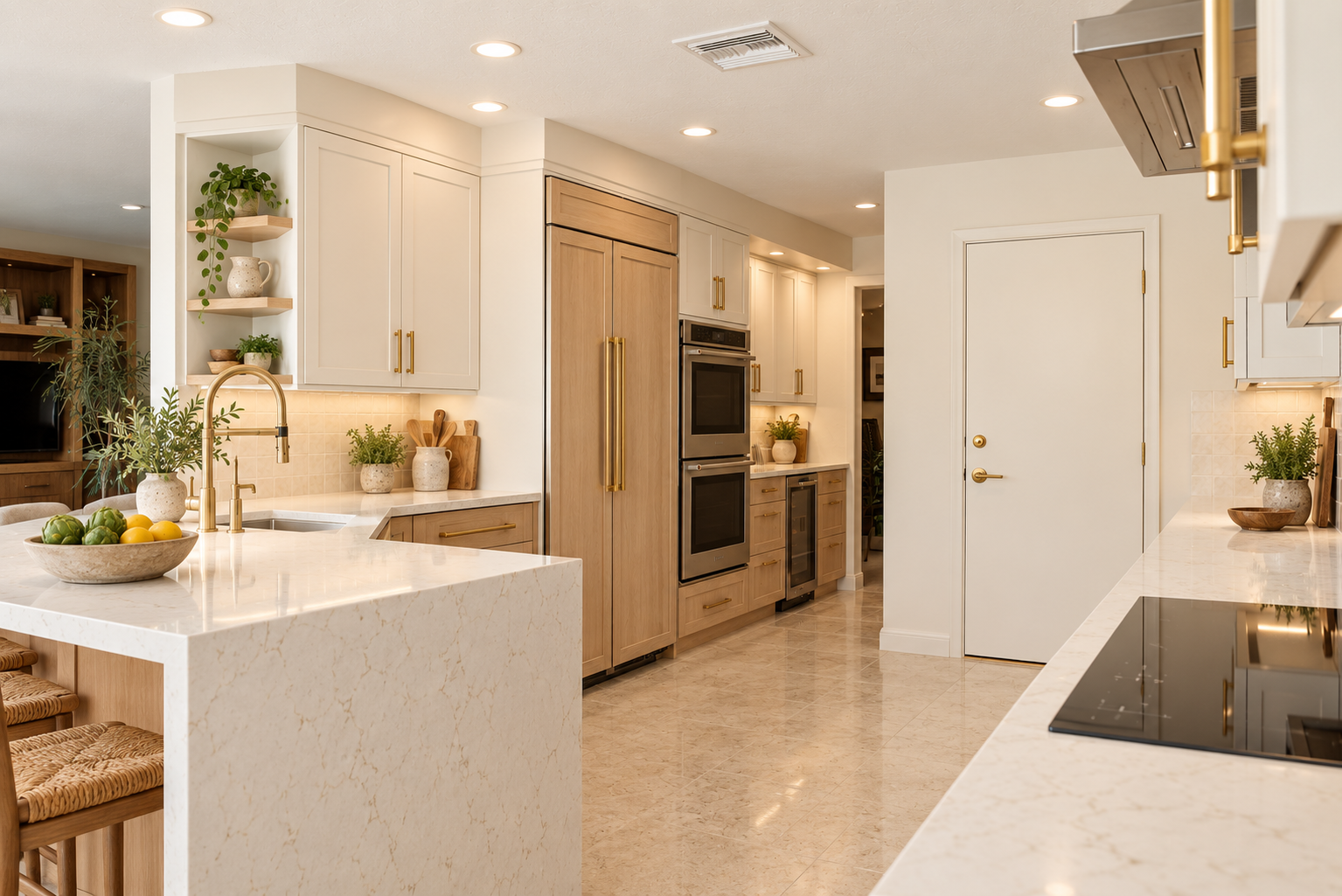
What do stock, semi-custom, and custom cabinets mean?
Stock or standard cabinets are built around a manufacturer’s catalog of set sizes, doors, and finishes. The designer combines those modules to fit your kitchen. That does not mean the design has to look generic. Careful cabinet placement, trim, end panels, and installation make a large difference.
Semi-custom cabinets start with a catalog but allow selected changes, such as a modified depth, a different interior, or a specialty cabinet. The amount of flexibility varies greatly by line. Always get the permitted modifications in writing.
Fully custom cabinets are designed and built for a specific project. A cabinetmaker can adjust dimensions, details, materials, and finish choices far beyond a standard catalog. That flexibility adds design, fabrication, finishing, and often installation labor.
These are descriptions of flexibility, not grades of quality. An expensive custom box with poor hardware or a weak finish is not automatically better than a carefully specified catalog cabinet. Likewise, ready-to-assemble describes how a cabinet ships, not whether its materials or joinery are good.
Why do many homeowners choose a standard cabinet line?
Most kitchens can be laid out with common cabinet widths. When the available sizes line up well with the appliances, sink, and room dimensions, a standard line lets the homeowner put more of the budget toward counters, lighting, flooring, or better storage accessories. Catalog pricing also makes it easier to see what changes when you upgrade a drawer, add a panel, or select a taller wall cabinet.
We have seen homeowners choose standard lines because the available style and color already fit the kitchen they want. There is little reason to commission an entirely custom run just to recreate a familiar painted shaker door. The important work is measuring accurately, deciding where drawers matter, checking appliance clearances, and planning how the cabinet run ends at walls and openings.
That said, a standard line is not always the least expensive final result. Extra panels, accessories, trim, installation labor, and a layout that wastes space can narrow the gap. Compare the complete installed scope, not a box price alone.
How do J&K, ProCraft, and local custom cabinetry differ?
J&K Cabinetry
J&K is a useful example of a manufacturer with defined door styles and finishes that many homeowners would call a standard cabinet choice. J&K also describes its offering as semi-custom, so the right question is which sizes and modifications are available for the particular line in your market. A catalog can offer attractive doors and useful storage without giving you every width or any paint color you imagine.
ProCraft Cabinetry
ProCraft Cabinetry publishes a modification program for its framed cabinets. Its current product information lists options such as depth changes, glass-door preparation, finished interiors, and toe-kick changes. That makes it a good example of why “standard” and “semi-custom” can overlap in practice. Confirm the current catalog, finish samples, and modification limits before you approve an order.
A local custom cabinet shop
A custom shop can build around an unusual wall, make a cabinet at a specific width, repeat a detail from another room, or develop a finish outside a catalog. That is valuable when the design calls for it. It also means more individual decisions, shop drawings, finish samples, and production work. Ask who measures, who builds, who finishes, and who installs. Those responsibilities can change the total price and the way problems are resolved.
Will custom cabinets eliminate fillers?
Custom sizes can reduce awkward gaps and make a cabinet run look more intentional. They do not eliminate every filler. A door or drawer next to a side wall may need space to open without hitting the wall, handle, or neighboring trim. Walls are rarely perfectly straight, so the installer may also need a scribed piece to close the run cleanly.
A filler is not automatically a design mistake. A wide, unexplained blank strip can be one, but a narrow, planned clearance at the wall protects the function of the cabinet. Before ordering, ask to see the cabinet plan with every filler and finished panel marked. Open the doors and drawers on the drawing, especially at corners, beside appliances, and near a doorway.
What changes when you want a specific cabinet color?
Manufacturer lines normally limit you to their current finish palette. That can be a good trade if one of the offered whites, grays, wood tones, or stains works with your flooring and countertop. Always view a real door sample in the room’s daylight and evening light. A screen image is not enough for a cabinet color decision.
Custom cabinetry can be finished in nearly any selected paint color, with more control over sheen and details. “Any color” still requires a physical sample and a clear finishing specification. Substrate, application method, curing, touch-up expectations, and long-term maintenance all affect the result. When comparing bids, confirm whether sample approval and the final finish are included.
How do you compare cabinet quotes fairly?
Two cabinet quotes can appear far apart because they describe different kitchens. One may include crown molding, end panels, rollouts, soft-close hardware, delivery, and installation; the other may list only cabinet boxes. Request the same plan and the same list of features from each supplier.
- Layout: cabinet widths and heights, island dimensions, appliance openings, fillers, and finished ends.
- Construction: box material, drawer box, hinges, slides, and shelf details.
- Finish: door material, sample approval, exposed sides, and touch-up process.
- Storage: drawers, pullouts, pantry fittings, and any specialty interior.
- Services: measuring, drawings, delivery, installation, adjustments, and warranty support.
Measure the actual appliances before the cabinet order is final. A change in refrigerator width, range style, or dishwasher panel can affect the surrounding cabinets. Make sure the quote explains who is responsible if a field measurement differs from the drawing.
For an early budget check, try our kitchen remodel cost calculator. It can help you weigh cabinet choices against the rest of the remodel before you compare detailed, measured quotes.
Which cabinet route makes sense for your remodel?
Start with the kitchen you have, not a category label. If a catalog line gives you the layout, door, finish, and storage you want, it is often a sensible place to begin. Semi-custom modifications can solve a few problem areas without making the entire kitchen a bespoke build. Fully custom work is easier to justify when the room has difficult dimensions, you need a specific construction detail, or the design depends on a finish and proportion you cannot get otherwise.
Our advice is to put the drawings side by side and look at the parts you will use every day: the sink base, drawers near the range, pantry access, and the way doors open against walls. Spend where those details improve the kitchen. A cabinet line should support the plan, not force the plan into a name.
Questions homeowners ask about kitchen cabinets
Are semi-custom cabinets always better than stock cabinets?
No. Semi-custom means more available changes, not a guaranteed improvement in materials or installation. Compare the exact cabinet line, hardware, finish, and complete scope.
Are custom cabinets worth the extra cost?
They can be when a specific dimension, detail, or finish matters enough to justify individual fabrication. If a standard line already gives you the layout you want, custom may not improve the daily use of the kitchen enough to warrant the added cost.
Can custom cabinets remove all filler strips?
No. Custom sizing can reduce some gaps, but doors and drawers still need clearance at walls and trim. An out-of-square wall may also require a scribed finishing piece.
Can I get any paint color on custom cabinets?
A custom finisher can usually match a very broad range of colors. Approve a physical sample and confirm sheen, finish method, and touch-up expectations before production.
Should I pick cabinets before countertops and appliances?
Coordinate them together. Appliance dimensions affect cabinet openings, and the cabinet layout affects countertop seams, overhangs, and sink placement. Final selections should be checked against one measured plan before ordering.