Good to Know / Deck repair and replacement
Can You Replace Deck Boards Without Replacing the Frame?
Yes, you can replace deck boards without replacing the frame if the structure underneath is sound and suitable for the new decking. That includes the joists, beams, posts, footings and, on an attached deck, the connection to the house. Removing the old boards gives the contractor access to areas that are difficult to check from below.
A worn walking surface does not always mean the entire deck needs rebuilding. But new boards should not cover a frame that needs repairs. Before choosing a color or comparing installation prices, find out what can stay, what needs attention and whether the existing layout still works for you.
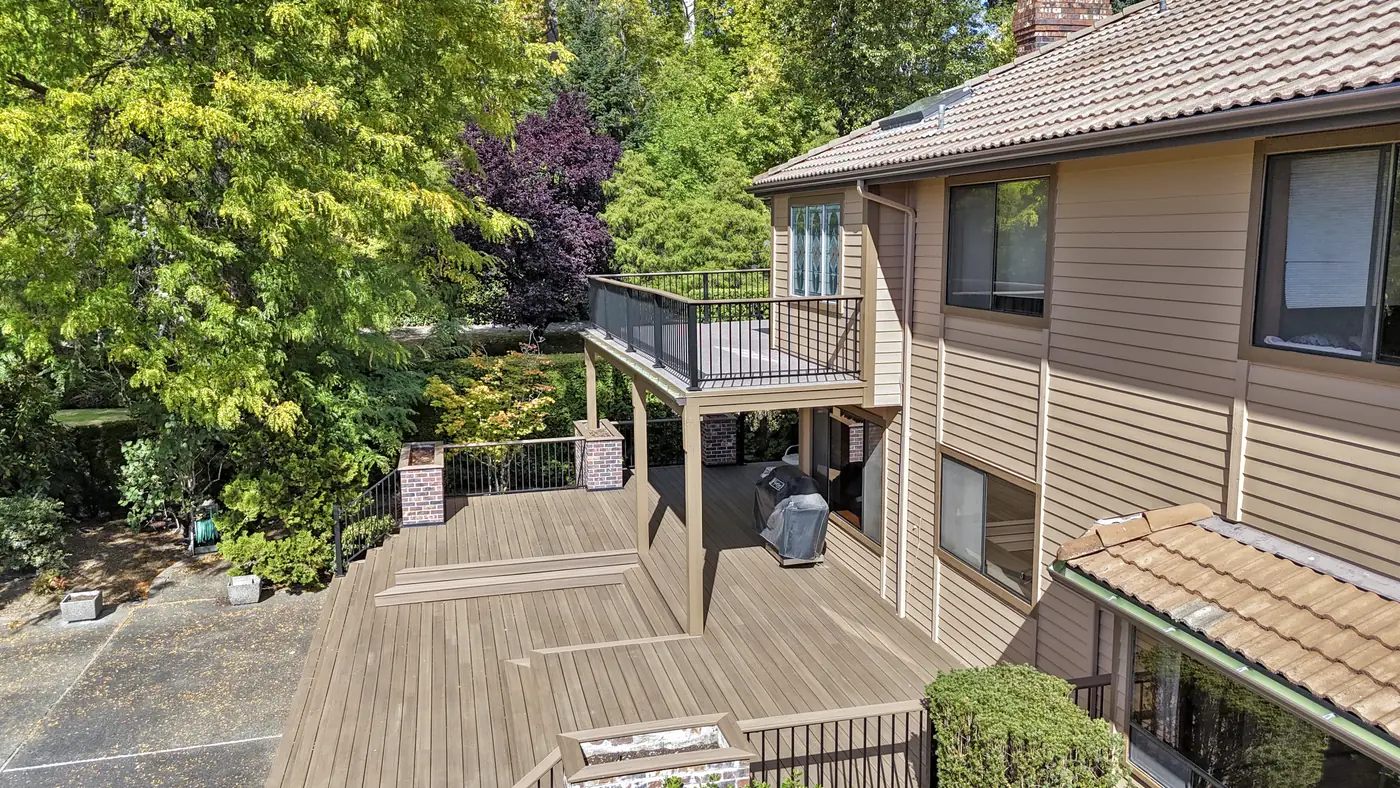
This guide explains how to make that decision, with photographs from our completed Edgewood deck renovation in Washington.
01 / Choosing the scope
When does replacing the deck boards make sense?
Board replacement, often called deck resurfacing, makes sense when the surface has reached the end of its useful life but the supporting structure can continue to do its job. In this article, resurfacing means removing the old boards and installing new ones. Painting or applying a thick coating is a different scope.
Think about the deck you want to have after the work. If its size, height and stair location already suit your home, keeping suitable framing may be worthwhile. If you want to enlarge the deck, relocate the stairs or carry a different load, the structure needs to be evaluated for those changes.
| Existing condition | Scope to discuss |
|---|---|
| A few damaged boards; surrounding decking and support are sound | Replace individual boards and investigate the cause of the damage. |
| Widespread surface wear; suitable framing beneath it | Replace the walking surface, with any identified framing or hardware work. |
| Localized framing damage; the rest can be retained | Plan the structural repairs before installing the new surface. |
| Extensive decay, inadequate support or a substantially different layout | Compare a rebuild with the full cost of repairing and adapting the old frame. |
There is no useful rule that every deck over a certain age must be torn down. Age helps describe the history; condition and suitability determine the scope. Ask for the reasons behind a recommendation to keep or replace the frame.
02 / Under the boards
What needs checking before the frame can be reused?
A contractor needs to evaluate more than the joists visible from the yard. TimberTech’s installation guidance identifies damaged framing, incorrect spacing, loose or rusted fasteners and an insecure or rotted ledger among the problems to look for in an existing structure.
Joists and the places where boards were fastened
Joists are the closely spaced members directly under the decking. Their tops may have damage concealed by the old boards, particularly around fastener holes and places that stayed damp. The inspection should address their condition and suitability for fastening new decking.
A surface stain alone is not a diagnosis of rot. Likewise, a joist that looks acceptable from underneath may have damage on top. Ask the contractor to show you the exposed areas and explain the proposed repair. Tape or longer screws should not be used to avoid replacing wood that has lost its strength.
Beams, posts and footings
The larger supporting members and their connections need assessment too. An uneven surface may involve the supports below, rather than just the boards above. The review should include signs of deterioration, movement and inadequate bearing. A deck that is pulling away from the house, visibly sagging or unstable needs assessment before continued use.
The connection to the house
On an attached deck, the ledger transfers loads to the house. Its attachment and flashing deserve close attention. The American Wood Council’s residential wood deck guide includes ledger attachment and corrosion-resistant flashing details. It is a reference for covered deck configurations, not a substitute for the requirements that apply to your particular home.
For a freestanding deck, the support arrangement differs. In either case, the new surface is only one part of the work. The inspection should also cover hardware, stair framing and railing attachments that will remain.
03 / Changing materials
Can you replace wood deck boards with composite or PVC?
Yes, when the existing structure can support the selected product and its installation requirements. Trex describes resurfacing an existing deck as an option when the foundation and framing are sound. Its process includes checking framing, hardware and joist alignment before installing new decking.
Wood, wood-plastic composite and PVC boards are not interchangeable specifications. Decide which product line and board profile you want, then check its requirements against the exposed frame. Stair treads, diagonal patterns, board ends and perimeter borders can require different support arrangements.
Is 16-inch joist spacing enough?
It depends on the board and installation. TimberTech’s joist-spacing guide shows 16 inches on center for horizontal board placement and 12 inches for diagonal placement, with a stated exception for its MAX boards. Those examples are not a blanket specification for every product or stair.
Measure spacing from the center of one joist to the center of the next. Also distinguish that measurement from the joist’s unsupported span, which is the distance it carries between supports. Adding another joist to meet a decking requirement does not automatically correct an undersized beam or an inadequate footing.
Will new boards hide an uneven frame?
Expect the joist tops to need checking before installation. New decking can follow the unevenness underneath it and leave a wavy finished surface. The contractor should plan how to correct the support without compromising the framing. Ask how that work is included in the quote rather than assuming the new boards will flatten everything.
For board spacing, fasteners, ventilation and support limits, use the current installation guide for the exact product being installed. A detail remembered from a different deck may not apply to yours.
04 / Railings and steps
Can the railing and stairs stay when the boards are replaced?
Sometimes. The answer depends on their condition, how they attach and whether they obstruct removal and installation. A railing post that passes through the deck surface is different from one mounted on top of a board. The connection must be evaluated before a contractor promises that everything can remain in place.
Changing the thickness of the walking surface can also affect the transitions at stairs and doorways. Stair work should address the supporting stringers and finished riser consistency, not just the appearance of the replacement treads. An old railing that looks straight still needs its anchorage checked.
If you want a different railing at the same time, compare it as a separate item. Our deck railing comparison can help with that selection. Keeping a suitable railing may reduce the scope; replacing one may change the framing and blocking work as well as the visible finish.
05 / Comparing estimates
Is it cheaper to replace deck boards or build a new deck?
Replacing boards can cost less when most of the structure is suitable for reuse. It avoids some demolition, framing and foundation work. The saving gets smaller when the old frame needs extensive repairs, extra supports or time-consuming correction.
A price per square foot of decking does not describe the complete job. Two decks with the same walking area can have very different stairs, railings, access and framing conditions. A low deck close to the ground can also be difficult to inspect and work beneath.
Ask for a written estimate that separates the following:
- Removal and disposal of the old boards.
- The selected decking product, fasteners, fascia and installation.
- Identified framing repairs and additional support for the board layout.
- Railing removal, reuse or replacement.
- Stairs, doorway transitions and related finish work.
- Permit responsibilities and any required design or inspection work.
- How concealed damage will be documented, priced and approved.
Some conditions will remain unknown until the surface is removed. Agree on that process before demolition. A contractor should explain what is included in the base price and what would require your approval as additional work.
If repairs are substantial, request a rebuild alternative with the same decking and railing selections. Comparing a basic resurfacing estimate with a fully redesigned new deck makes it difficult to see where the money is going.
06 / Washington permits
Do you need a permit to replace deck boards?
Check with the building department responsible for the property before work starts. A limited surface repair and a project that changes framing, stairs, railings or deck dimensions may be treated differently. Calling the work resurfacing does not establish whether it is exempt.
For properties in unincorporated Pierce County, the county’s predesigned deck guide states that a building permit is required for residential decks more than 30 inches above grade, measured as described in the guide. It also identifies site conditions that can require additional review. This guidance does not mean every lower deck or every repair is exempt in every city.
Use the jurisdiction for your address. An Edgewood or Puyallup address is not enough by itself to establish whether a city or the county reviews the work. Give the department the deck height, attachment, planned material change and any structural work, then confirm the requirements for that scope.
Where a framing inspection is required, schedule it before the new boards cover the work. The proposal should identify who obtains the permit and arranges inspections.
07 / A completed project
How we approached the existing frame in Edgewood
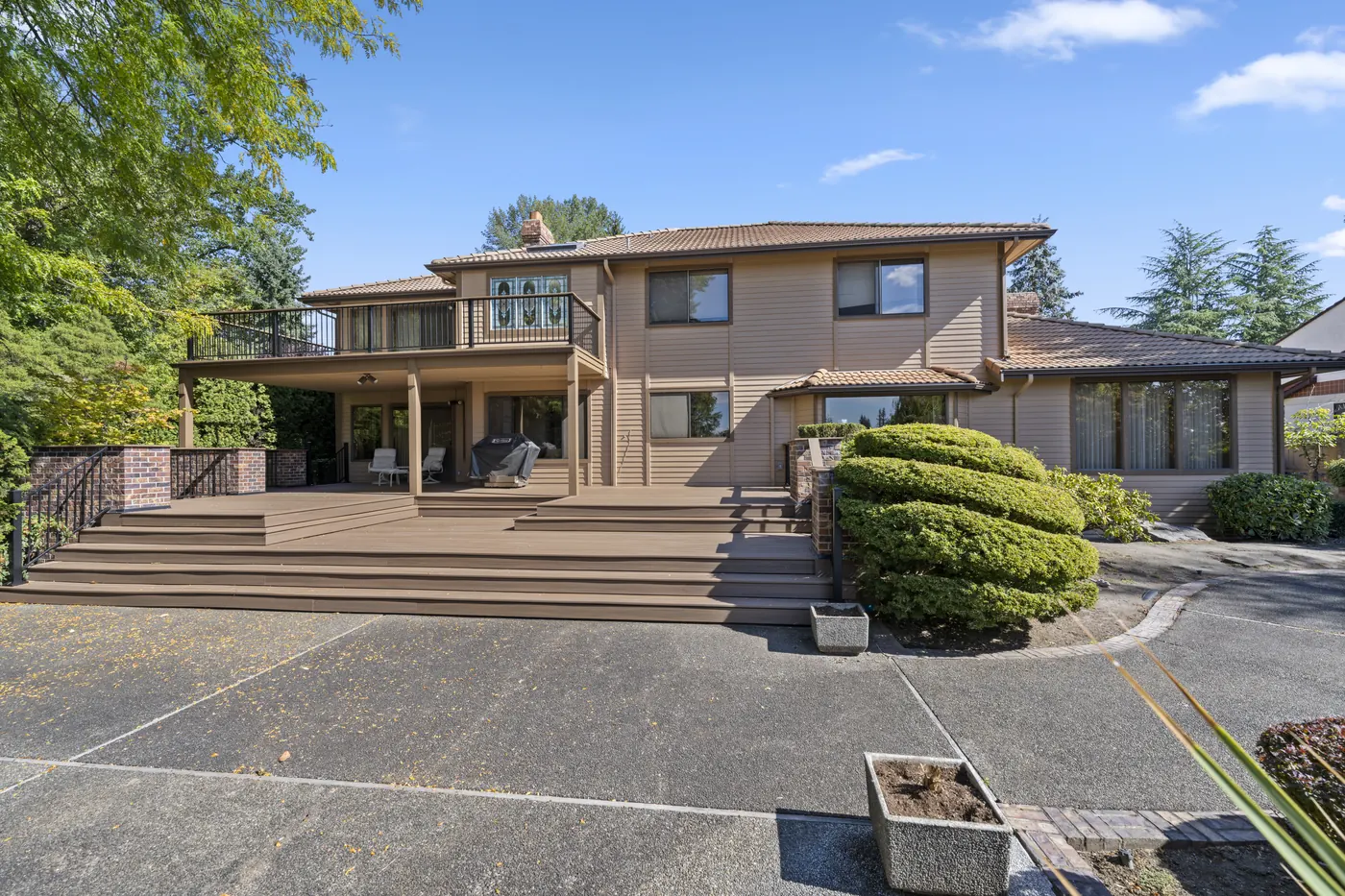
At our Edgewood AZEK deck and exterior renovation, completed in 2025, we removed the existing wood decking and inspected the framing. Structurally sound sections were reused where applicable. The replacement decking was TimberTech AZEK PVC in English Walnut.
The project also included the upper balcony, dock replacement and other exterior work. Balcony waterproofing had its own scope. A balcony that needs to keep water out of the structure cannot be evaluated only as a collection of replacement deck boards.
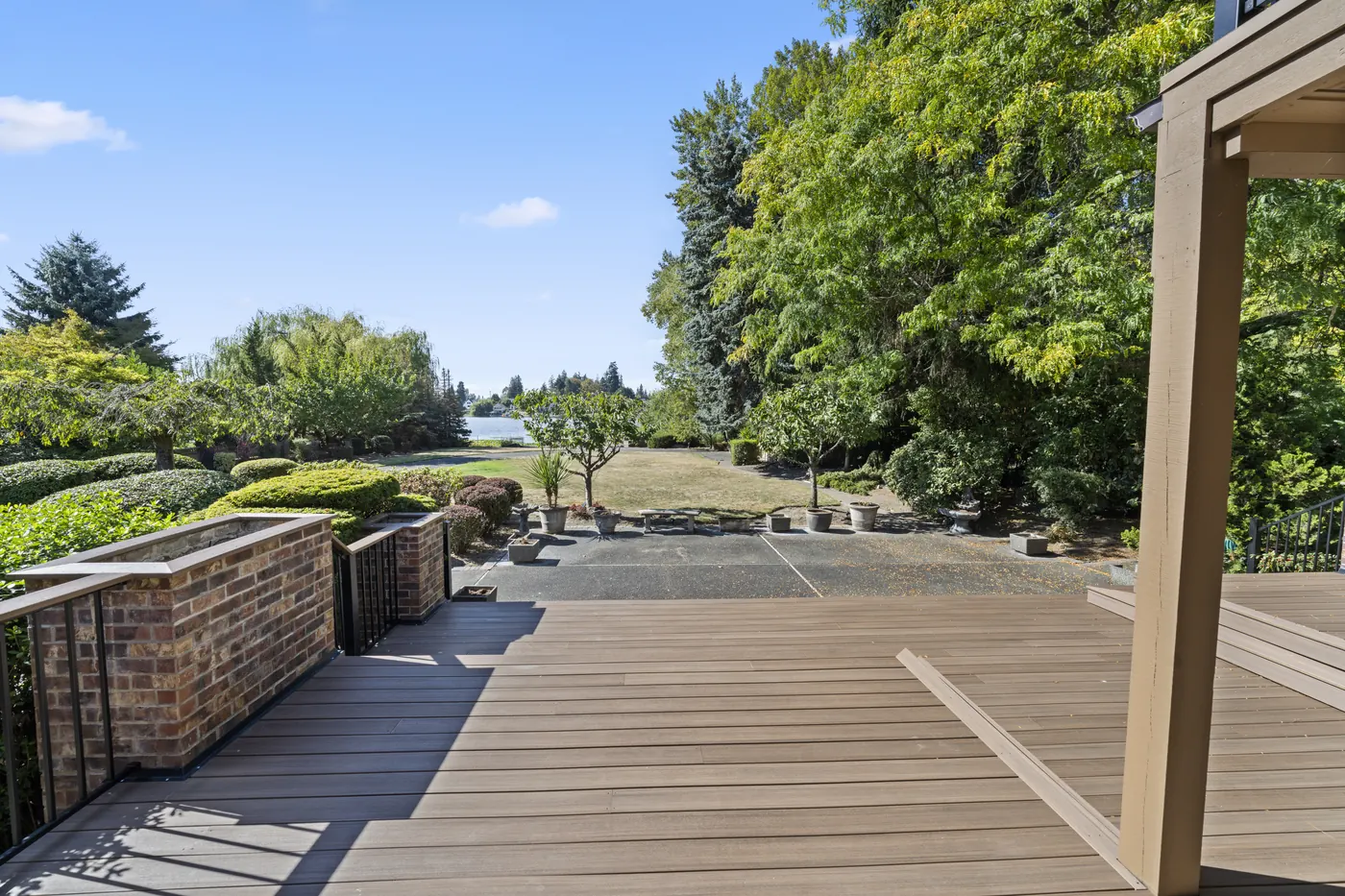
This project illustrates a workable approach to reuse: remove the old surface, assess the structure and keep suitable sections within the agreed scope. It does not establish what can be retained on another home. Your deck needs its own assessment.
Our Washington decking project gallery shows completed work at different scales. Use the pictures to compare layouts and finishes, then discuss the structure and condition of your existing deck separately.
08 / Getting ready
What should you have ready for a deck replacement estimate?
Photograph the entire deck, its stairs, the connection to the house and any accessible supports. Take the pictures from safe positions; there is no need to climb underneath an unstable deck. Note where boards feel loose, water tends to collect or a railing has moved.
Bring any original plans or permit records you have. Describe what you want to keep and what you want to change: the footprint, railing, stair location, board material and maintenance routine. That gives the contractor something concrete to assess.
Before accepting the proposal, ask: Which parts of the frame are expected to stay? What needs further inspection after removal? Does the selected decking need additional support? How will you approve concealed repairs? The answers should make the proposed scope easier to understand.
Planning a deck replacement in Washington?
Bezruchuk Inc. builds and replaces Washington decks. Send photographs, your location and the changes you have in mind so we can discuss the scope. Learn about our Washington deck building and replacement service, or start with a quote request.
09 / Homeowner questions
Questions about replacing deck boards
Can you replace just a few deck boards?
Yes, if the damage is localized and the supporting structure is sound. Match the replacement board's dimensions and fastening requirements, and investigate what damaged the old board. New boards may look different from weathered ones.
Can you put new decking over the old boards?
For the board-replacement approach described here, remove the old boards first. This exposes the frame for inspection and provides the access needed for repairs and fastening. A specialized overlay product has its own requirements and is a different scope.
Can a 20-year-old deck frame be reused?
Possibly, but age alone cannot establish that it is suitable. The framing, supports, hardware and house connection need assessment, along with the requirements of the new decking. Remaining condition matters more than an age cutoff.
Does composite decking always need joists 12 inches apart?
No. Required support spacing depends on the exact product, board orientation and application, including stairs. Check the current manufacturer's installation guide rather than applying one spacing rule to all composite or PVC decking.
Will joist tape fix a rotten deck frame?
No. Joist tape is a moisture-protection measure for suitable framing, not a structural repair. Deteriorated wood and the source of the damage need assessment before the new surface is installed.
Can longer screws secure new boards to damaged joists?
Longer screws do not establish that a damaged joist can safely support new decking. Have the framing assessed and repaired as needed, then use fasteners specified for the decking and supporting material.
Can I keep the railing when replacing the deck boards?
Sometimes. Its condition, anchorage and relationship to the boards determine whether it can stay in place or needs temporary removal, repairs or replacement. Include that decision in the written scope.
How much does it cost to replace deck boards?
The complete cost depends on deck area, the selected boards, demolition, access, stairs, railings and framing work. Request a measured estimate that separates those items and explains how concealed damage will be priced and approved.
Do I need a permit if I am keeping the deck frame?
Keeping the frame does not automatically make the work permit-exempt. Ask the building department for your address about the exact scope, including changes to decking material, railings, stairs or structural components.